Indoor Installations of Land Art: Systems of Site Specificity, Indexical Material, and Bodily Scale
By Te Palandjian
Publisher’s Erratum: Corrections to Indoor Installations of Land Art: Systems of Site-Specificity, Indexical Material, and Bodily Scale by Te Palandjian
While we strive to produce a journal of the highest standard, sometimes we fall short and in this case we would like to acknowledge those errors here in issuing the revisions below.
In the contribution, Indoor Installations of Land Art: Systems of Site-Specificity, Indexical Material, and Bodily Scale by Te Palandjian (Issue 13: “super trivial mega small extra common ultra boring,” Room One Thousand Issue 13 (2025): 94-105), there were callouts, footnotes, and text [11, 13, 14, 15, 16, 17, 25] incorrectly entered or removed and have been corrected.
Footnote [23] has been correctly edited to: Her use of natural material does not achieve psychological “stacked landscape” references or experiences for the audience. I would argue instead, that these bronze and matte black paintings, with their non-indexical titling, privilege imagery and fiction over landscape and material.
Paragraph 18 has been correctly edited to: Upon closer examination of Fernandez’s oeuvre, I am unconvinced that her artwork centers the “landscape stacking” concept. In a National Gallery short film, Fernandez discusses her “Dark Earth” painting series, where she makes “[2D multimedia paintings of] landscapes with pieces of the real landscape—because these are made from burned trees — [there is] this way of being in more than one place at once, and [she] often [refers] to this as landscape stacking.”
Paragraph 27 has been correctly edited to: The signifiers of the body are readily apparent, even in artworks that do not directly depict my appendages. My works, particularly those employing denser materials, tend to hover between four and five feet in height. Within the gallery context, I believe that bodily scale functions not as an immersive experience, but rather as a touchstone for accessing the psyche. In collaborative works with Nele, scale shifts, reaching 10 to 15 feet on a single side, reflecting the expanded capability of two laborers.
Paragraph 28 has been correctly edited to: The critical turn for me lies in bringing the site indoors. While my outdoor works communicate directly with their surrounding landscape, indoor work positions me as the arbiter, with the sculpture serving as a new totem that stacks landscape with an accompanying psychological map. I am reminded of this when I wear my jeans in the city shortly after coming back from a site-trip. I reach into my pocket and find a little sand: a bit of land journeyed and resituated, specific to my memories, broad in its conceivable origin in a multiplicity of landscapes.
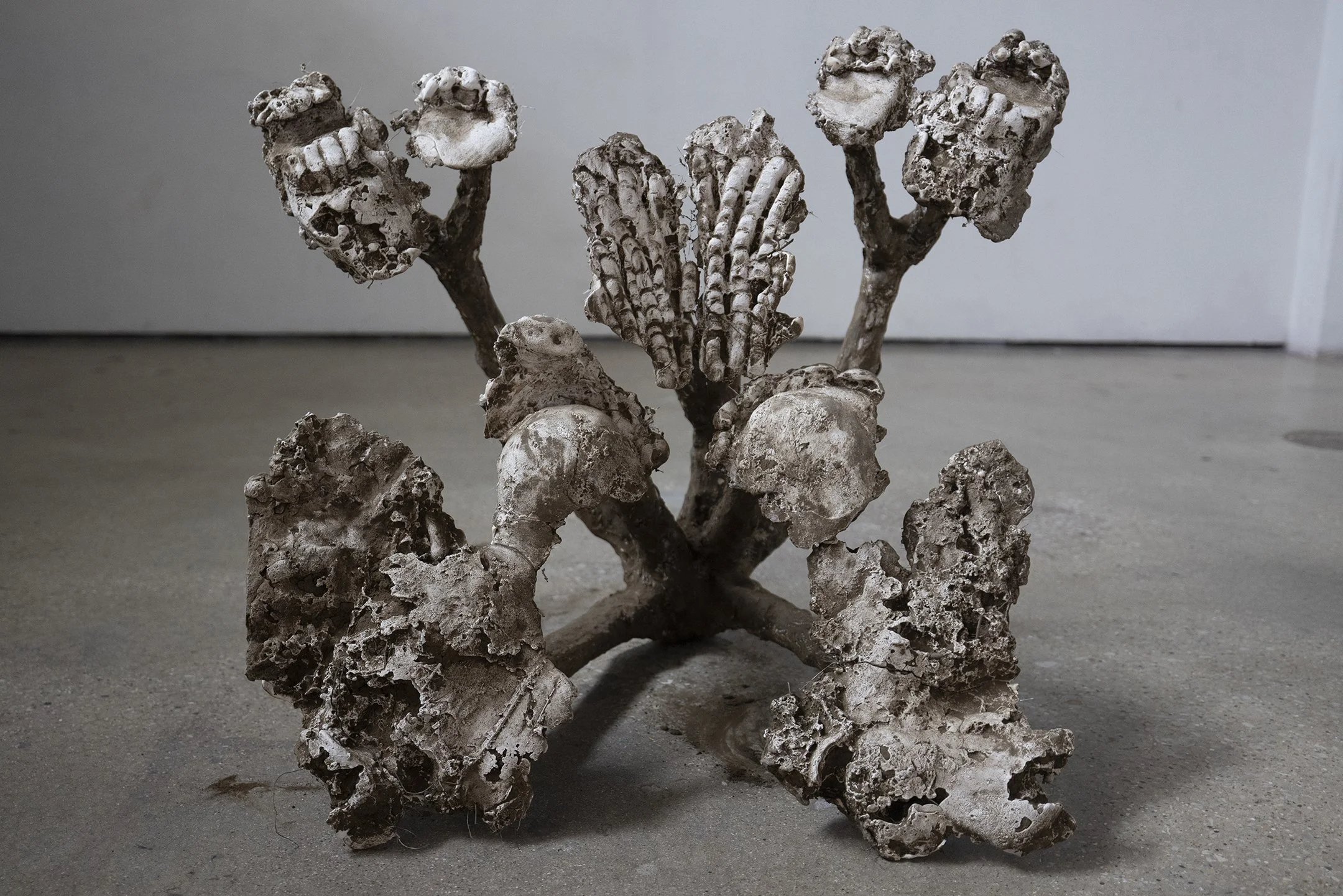
Te Palandjian, Rorschach Test (2024).
While the emergence of Land Art in 1960s America occurred as a partial rejection of the museum and gallery context in favor of the unsaleable, the remote, and the sublime, indoor land art is critical to our historical understanding of the field. It allows for a heightened awareness of the ways materiality, bodily scale, and psychological processes shape our understanding of landscape. This article interrogates the complex role of site in land art, focusing on the relocation of environmental signifiers—natural materials imbued with indexical resonance—from their originating landscapes into interior spaces. Moving beyond definitions of land art that prioritize in situ presence, I argue that the essence of land art lies in its directedness toward specific landscapes, a directedness amplified by the interplay between material, body, and viewer. In examining Robert Smithson’s nonsites and comparing his framework to modern and contemporary shifts in the work of Ana Mendieta and Teresita Fernández, I will present an analysis of the field that profoundly shapes my own artistic engagement.
Why Did Land Art Come About And What Is It?
The efflorescence of land art in 1960s and ’70s America puts forth a compelling historical question. While ancient interventions in the landscape—such as the Desert Kites of Jordan (10,000–2,200 BCE), Newgrange in Ireland (3200 BCE), the Serpent Mound in Ohio (300 BCE), and the Nazca Lines in Peru (500 CE)—offer tantalizing precedents, it is crucial to distinguish between these manifestations of societal necessity and the self-conscious artistic project that emerged in the latter half of the twentieth century. The Desert Kites, for instance, initially conceived as functional hunting mechanisms, were not apprehended in their totality until aerial reconnaissance in the 1920s [01], highlighting the critical role of technological mediation in shaping our understanding of landscape interventions. More broadly, the transition from ancient earthworks to the Land Art movement reflects a profound shift in societal priorities and artistic consciousness. While ancient works were often integral to ritual or survival, Land Art emerged in America [02] as a self-aware artistic practice, driven by a desire to engage with the landscape on a conceptual and aesthetic level.
In the preface to Land and Environmental Art (2006), Brian Wallis and Jeffrey Kastner situate American Land Art within a nexus of cultural and philosophical transformations. Emerging from—and in critical dialogue with—Minimalism and conceptual performance art,[03] artists such as Robert Smithson, Michael Heizer, and Walter De Maria sought to displace the primacy of the discrete art object, instead foregrounding process and the physical context of their interventions. Simultaneously, a burgeoning environmental consciousness, coupled with nascent legislative efforts, exerted a palpable influence on the American psyche. [04-07]
The site-specific nature of outdoor Land Art engendered a radical redefinition of the viewer’s relationship to the artwork. By demanding active engagement—requiring physical traversal and multiperspectival apprehension—land artists explicitly challenged the conventional paradigm of museum and gallery spectatorship, with its emphasis on fleeting, superficial encounters.[08] This rejection implicitly critiqued the increasing institutional control exerted by indoor art spaces, which often mandated physical remoteness from urban centers and imposed limitations on the duration and intensity of audience engagement. [09-10]
“The site-specific nature of outdoor land art engendered a radical redefinition of the viewer’s relationship to the artwork.”
While the Tate’s definition of Land Art—“art that is made directly in the landscape, sculpting the land itself into earthworks, or making structures in the landscape using natural materials such as rocks or twigs”[11]—acknowledges the genre’s foundational elements, it elides nuances pertaining to conceptual and indexical dimensions, as well as the relationship between site-specificity and geographical location. Consider the use of nontraditional materials like dirt and twigs by artists associated with the Arte Povera movement. These often-referenced precursors to Land Art represent a rejection of classical conventions yet lack direct engagement with the land or an emphasis on the provenance of natural materials.
Sigrid Holmwood, by contrast, employs plant-based dyes sourced from specific locales to explore themes of peasant painting traditions, sustainability, and the industrialization of artistic materials.[12] Her process includes collecting natural materials and creating fictional reenactments of herself as a peasant mining pigments. Yet from her writings, it appears that her work is centered on the historical contexts of pigments rather than on landscape itself. Though Holmwood’s work shares thematic overlaps with Land Art, her emphasis on painting and color decenter the landscape while maintaining it as a critical context.
These examples serve as instructive counterpoints, suggesting that while the use of natural materials or exploration of environmental themes may be characteristic of much Land Art, they are not sufficient criteria for its definition. Instead, I propose that an engagement with the landscape—and, crucially, the establishment of an indexical [13] relationship between artwork and site—constitute the defining “pivot” to which Kastner alludes when he says, “All [land art included in this book] has as its pivot the land and the individual’s response to and activity within it.”[14] I suggest that Land Art fundamentally operates as a conceptual “pointedness toward” a particular environment or landscape, facilitated by the legibility of its materials as indexically specific.
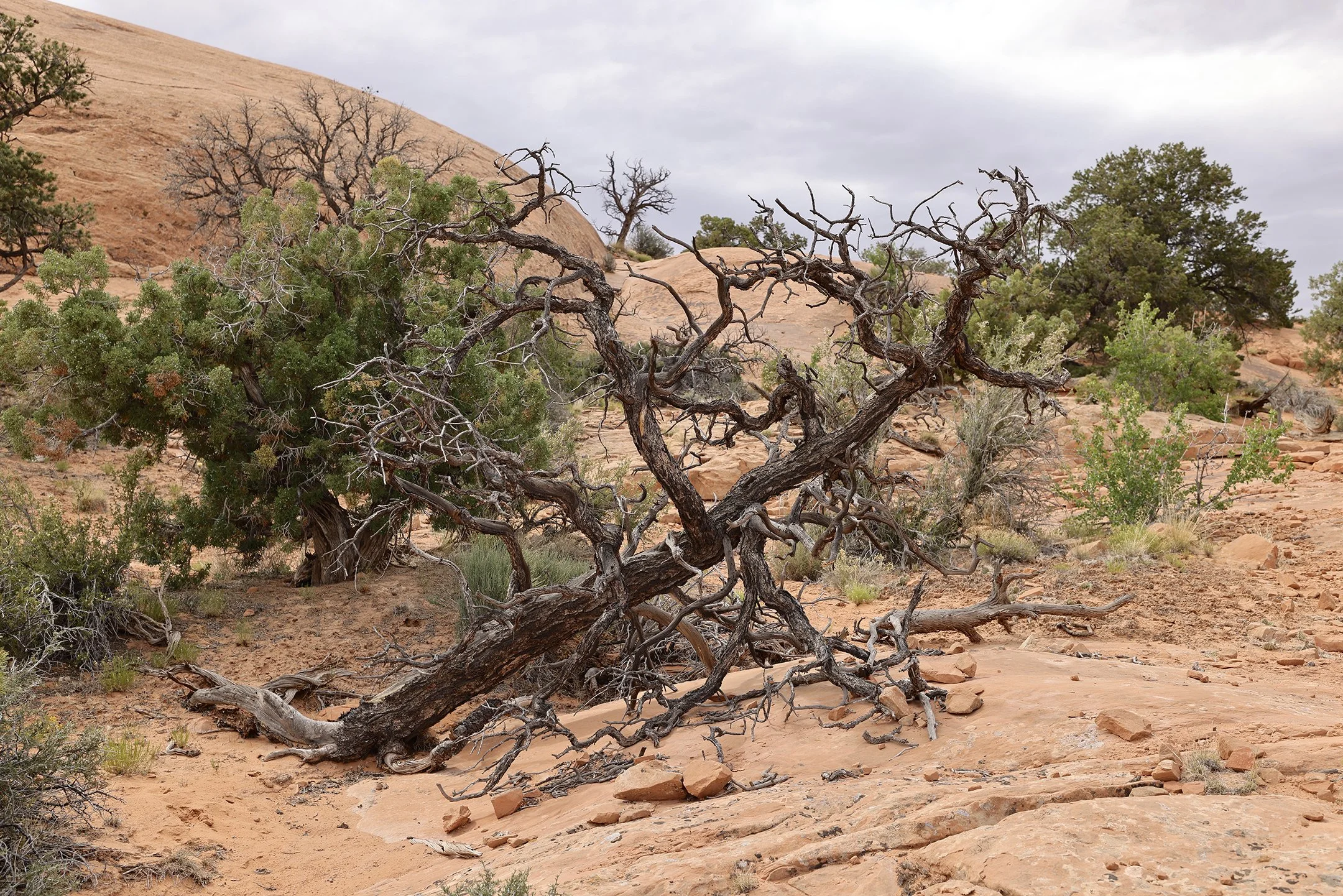
Te Palandjian, unknown (2024). Reference image taken in Canyonlands, Utah.
Smithson’s Site/Nonsite
Smithson conceived of the site as a dynamic, material entity, embodying the confluence of temporal and geological forces. Works such as Spiral Jetty (1970) at the Great Salt Lake and Broken Circle/Spiral Hill (1971) in the Netherlands transcend mere intervention, functioning as indices of temporal and spatial transformation. Constantly subject to geological processes, human agency, and the inexorable passage of time, Smithson’s sites become potent signifiers of existential questions—temporality, entropy, decay, and the sublime.
On June 14, 1968, Robert Smithson, accompanied by Nancy Holt and Michael Heizer, embarked on a journey to the Franklin Mineral Museum in New Jersey.[15] This expedition marked the beginning of a series of excursions to various sites throughout New Jersey, during which Smithson gathered rubble and minerals for his 1968 exhibition Earth Works at the Dwan Gallery in New York City.[16] The nonsite artworks in the show denoted indoor installations that Smithson conceived as metaphorical engagements with sites he had explored and excavated.
In A Provisional Theory of Nonsites (1968), Smithson defines nonsites as “three-dimensional logical pictures,” resisting direct mimetic representation of their originating sites.[17] By emphasizing the “space of metaphoric significance”—for example, the chasm between the Pine Barrens site and the nonsite itself, a space where “travel... is a vast metaphor”—Smithson posits that the nonsite functions not as a replica but as a physical extension inextricably linked to its source, while simultaneously constituting its own loaded site. He elaborates: “Everything between the two sites becomes physical metaphorical material devoid of natural meanings and realistic assumptions.”[18] This process of abstraction enables a unique mode of knowledge production about the site itself, resonating with structuralist and poststructuralist theories that prioritize conceptual frameworks over direct representation.
Thus, nonsites transcend a status as containers of natural material or shadows of their originating sites, functioning instead as autonomous zones of conceptual experimentation. They represent the distillation of a site’s physical and metaphysical complexity into abstract form, forging a third space between nonsite and site that is rich in metaphorical and metonymic potential.
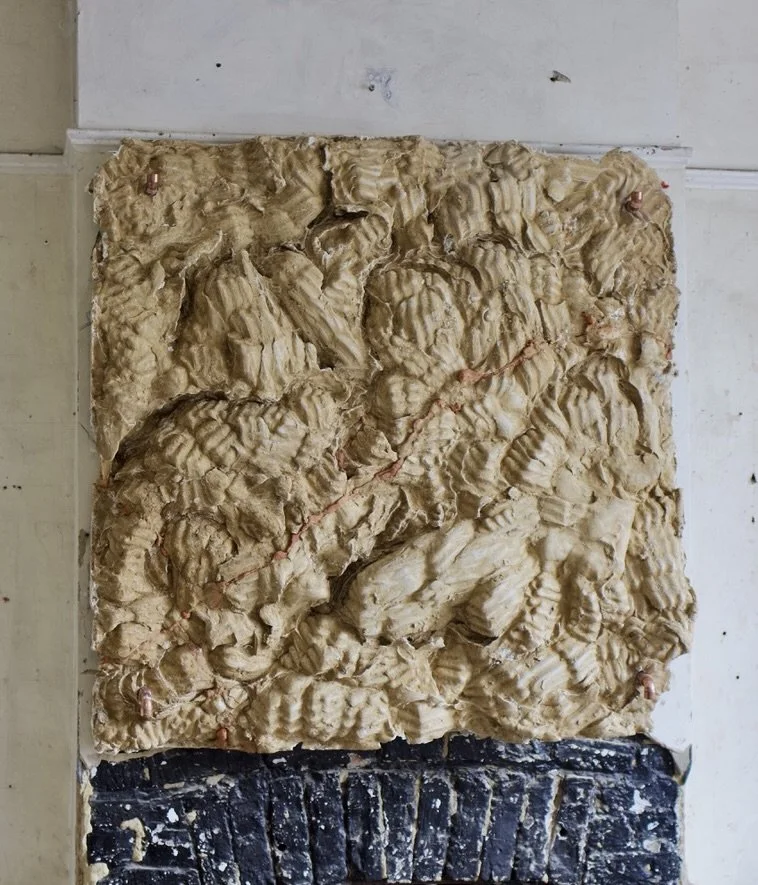
Te Palandjian, Energy Meter, 0.3 hrs (2024).
Smithson’s site/nonsite dialectic deconstructs the binary opposition between the natural world and the cultural artifact, positing them as interdependent entities. This engagement occurs within a complex intellectual milieu, leveraging metaphor and other cognitive processes to challenge conventional perception.
Contrary to the Tate’s assertion that Land Art is “made directly in the landscape,” I contend that the genre’s engagement with site-specificity is far more nuanced than mere physical presence. This distinction is crucial for understanding indoor works, such as Smithson’s nonsites, within the broader context of Land Art. By relinquishing a rigid adherence to outdoor sites—or, in other cases, to natural material use—and instead embracing a more expansive perspective that acknowledges the politicization of indoor space through the displacement of natural materials, we can better appreciate the tension inherent in reintroducing Land Art—a practice predicated on the rejection of exhibition—back into the exhibitionary complex.
... A Note On Indexicality
A critical aspect of engaging with nonsites lies in the audience’s conviction that the natural materials originate from specific landscapes identified by Smithson. For instance, in Nonsite “Line of Wreckage,” Bayonne, New Jersey, (1968) he employed title and photographic documentation of excavation sites to underscore the provenance of materials used in his nonsites. These titles and images serve as site-pointing signifiers, foregrounding an indexical relationship between material and place, anchoring the nonsite to its source in the wreckage at Bayonne.
Smithson’s Nonsite, Site Uncertain (1968) presents a particularly compelling case, as the customary delineation of the originating site is replaced with an explicit designation of uncertainty. This deliberate ambiguity compels the viewer to scrutinize the material, registering the dark natural matter as a readily identifiable form of coal. Kirsten Swenson, in her 2023 essay The Last Nonsite: Nonsite, Site Uncertain, Politics, and Prehistory, notes that Smithson specified “cannel coal,” a variant found in southern Ohio and Kentucky, which he had learned about in a handbook of rocks and minerals.[19] Swenson observes that cannel coal— closely associated with domestic heating and illumination in midcentury America—was also the subject of intense debate in 1968, when Smithson created the work. She references a Life Magazine feature on “the new earth-moving machines,” including aerial images of Kentucky surface coal mines captioned, “Strip miners in Kentucky are violently defacing the land and ruining lives.”[20]
Swenson’s reading elucidates how Smithson’s coal—despite its unspecified origin—retains an indexical charge, potentially enhancing audience engagement by invoking “site uncertain.” In the absence of explicit linguistic cues, the viewer is drawn into the political and ecological consequences of coal mining, especially in the Appalachian region. The work’s ambiguity intensifies the viewer’s interpretive labor, redirecting attention from named locations to implicated histories.
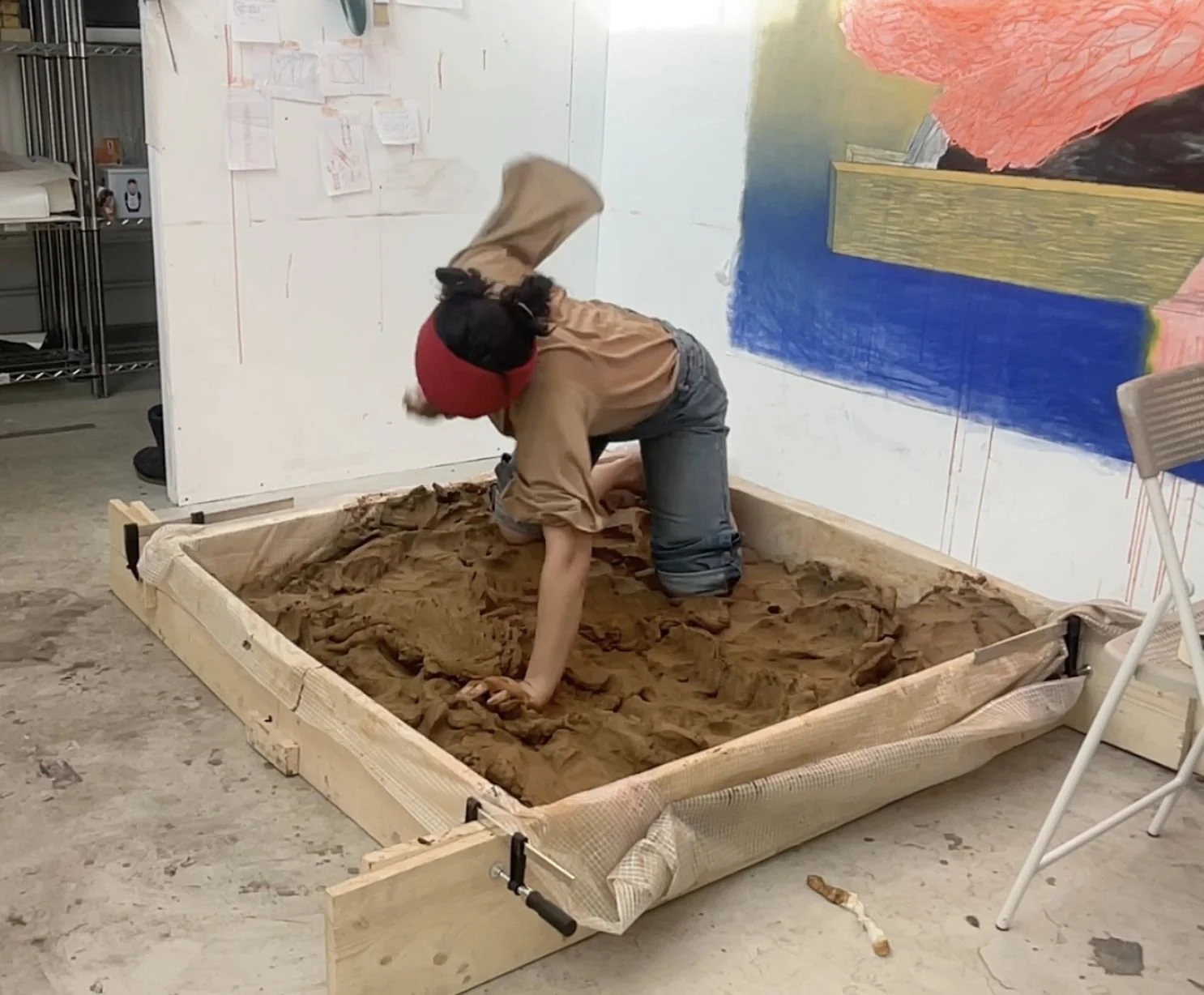
Te Palandjian, Energy Meter (process) (2024).
Landscape Stacking
Last year, SITE Santa Fe presented Teresita Fernández / Robert Smithson, described by the institution as “a subjective, intergenerational conversation between two artists, initiated by Teresita Fernández’s long-term engagement with challenging socially constructed ideas about place and landscape and by her immersive research on Robert Smithson’s art and ideas.”[21] In an interview conducted by SITE Santa Fe, Fernández articulated her perspective on Smithson’s concept of the nonsite, stating:
“[My conception] is very different than this binary idea of a site and a non-site, which in some ways are sort of like these polarities. I was more interested in, and continue to be interested in—this is my own term that I use in my work—‘stacked landscapes:’ it’s this idea that wherever you are, you’re actually in many, many places at once simultaneously and that this sense of site is actually structured or ordered in a way that is actually much more vertical... Landscapes are much more about what you don’t see than what you do see.”[22]
Fernández posits that landscapes possess the capacity to transport the viewer to multiple temporal and spatial locations simultaneously, suggesting that inhabiting a site entails a psychological confrontation with many overlaid places. Upon closer examination of Fernandez’s oeuvre, I am unconvinced that her artwork centers the “landscape stacking” concept. In a National Gallery short film, Fernandez discusses her “Dark Earth” painting series, where she makes “[2D multimedia paintings of] landscapes with pieces of the real landscape—because these are made from burned trees — [and thus there is] this way of being in more than one place at once, and [she] often [refers] to this as landscape stacking.”[23] Her use of natural material, does not achieve psychological “stacked landscape” references or experiences for the audience. I would argue instead, that these bronze and matte black paintings, with their non-indexical titling, privilege imagery and fiction over landscape and material.
“Landscapes are much more about what you don’t see than what you do see.” - Teresita Fernández
This may sound like a harsh assessment, but Fernández’s self-positioning in Smithson’s lineage invites scrutiny as to whether she metonymically produces what she describes; her notion of psychological landscape stacking is a rich and generative one.[24] Still, her psychological framework resonates with my own experience. Visiting the Princess of Wales Conservatory in 2022, I entered the desert climate room and was struck by the familiar scent, heat, and air dryness—triggering déjà vu from my travels in New Mexico and Utah. The densely arranged cacti evoked both an artificial “desert forest” and real-world ecological harvesting histories, such as those surrounding cochineal beetles on Opuntia species across Mexico, Spain, and Armenia.
A critical and successful development of landscape stacking occurred in the 1970s and ’80s through bodily scale. From 1973 to 1980, Ana Mendieta created her Silueta Series—site-specific interventions in Iowa, USA and Mexico using earth, fire, water, and her own body. These ephemeral works, which washed away or burned, were captured through photography. Around the same time, Beverly Buchanan erected Marsh Ruins, three tabby-cement mounds on Georgia’s coast. Richard Long began his River Avon mud drawings, created by slapping wet clay in circles with his hands.
Land Art’s male-driven, sublime beginnings—Spiral Jetty, City—found an evolution toward bodily scale and intimacy. Artists like Mendieta introduced the literal body as an indexical marker, using her silhouette and movements to register cultural memory, grief, and longing. Reflecting on her forced immigration to the United States under Operation Peter Pan, she wrote: “I am overwhelmed by the feeling of having been cast from the womb (nature). My art is the way I re-establish the bonds that unite me to the universe.”[25]
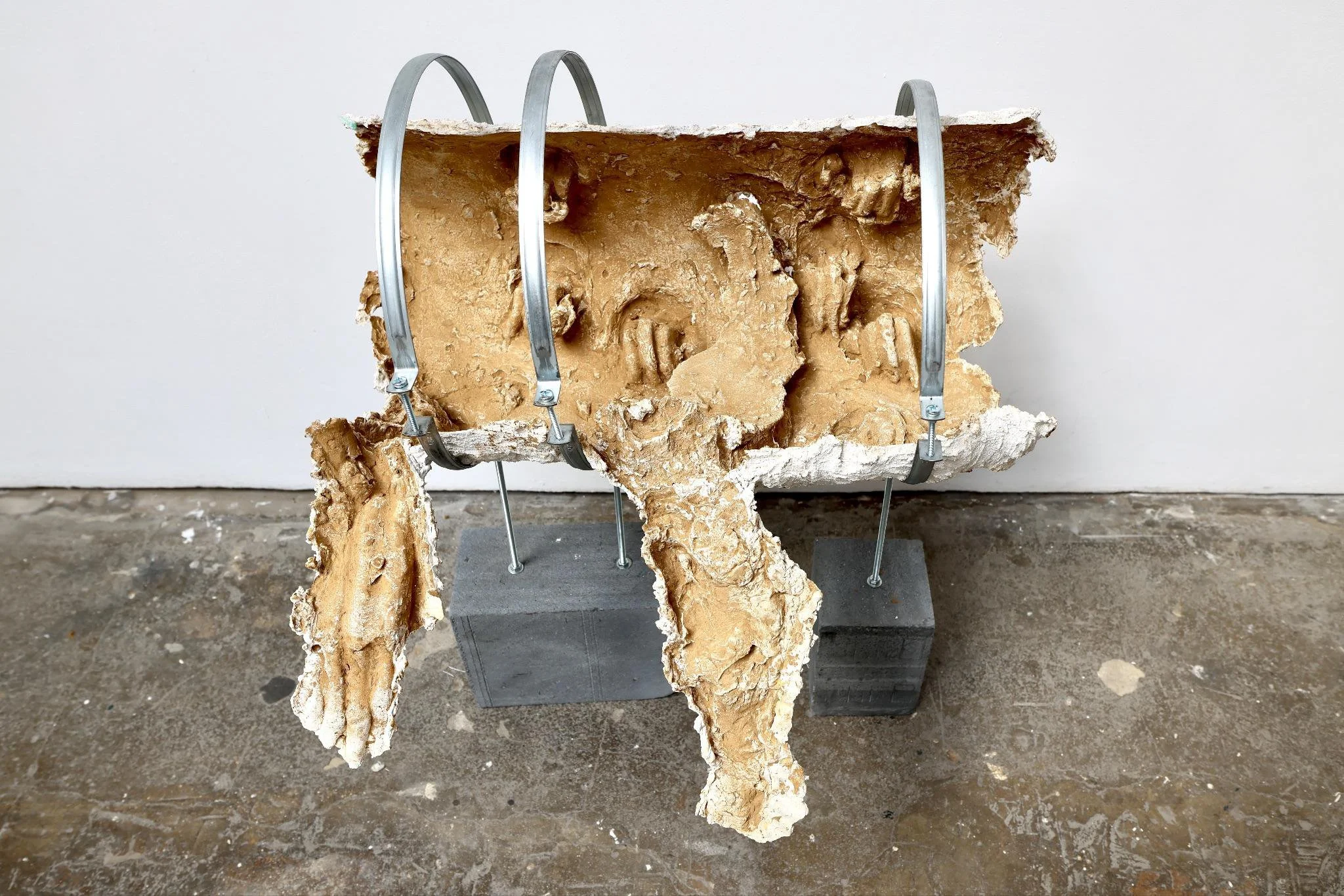
Te Palandjian, Displaced Fragments (2024).
While Siluetas were outdoor works, they share a critical structure with Nonsites. Both use a second site, indoors or elsewhere, to reflect upon and abstractly reconstitute a source landscape. Mendieta’s body becomes the indexical connector to Cuba, in contrast to Smithson’s use of labeled materials. Moreover, Nonsites may point not only to their source landscapes, but also to the gallery itself as a charged location. In both cases, the body of the artist, of the viewer, becomes implicated in the act of interpretation.
“Land Art’s male-driven, sublime beginnings—Spiral Jetty, City— found an evolution toward bodily scale and intimacy.”
Indexicality, in this expanded context, is fluid, using the body to facilitate psychological stacking. Smithson and Mendieta, despite differing methods, are both “landscape stackers.” Where Smithson is analytical and geologic, Mendieta is embodied and visceral. My own practice considers both modes, layering physical landscape materials and using the body as an interpretive stratum.
My Land Language: Indoor, Body-scaled, Stacked Developing
The contemporary terrain of Land Art is contested—marked by calls to climate action, the rise of immersive indoor environments functioning as simulacra, and the re-commercialization of landscape-based sculptures. My own practice enters at this juncture, focusing on what it means to “landscape stack” indoors, building upon the lineage of nonsites and the body-scaled, bodily Land Art practices of the late twentieth century.
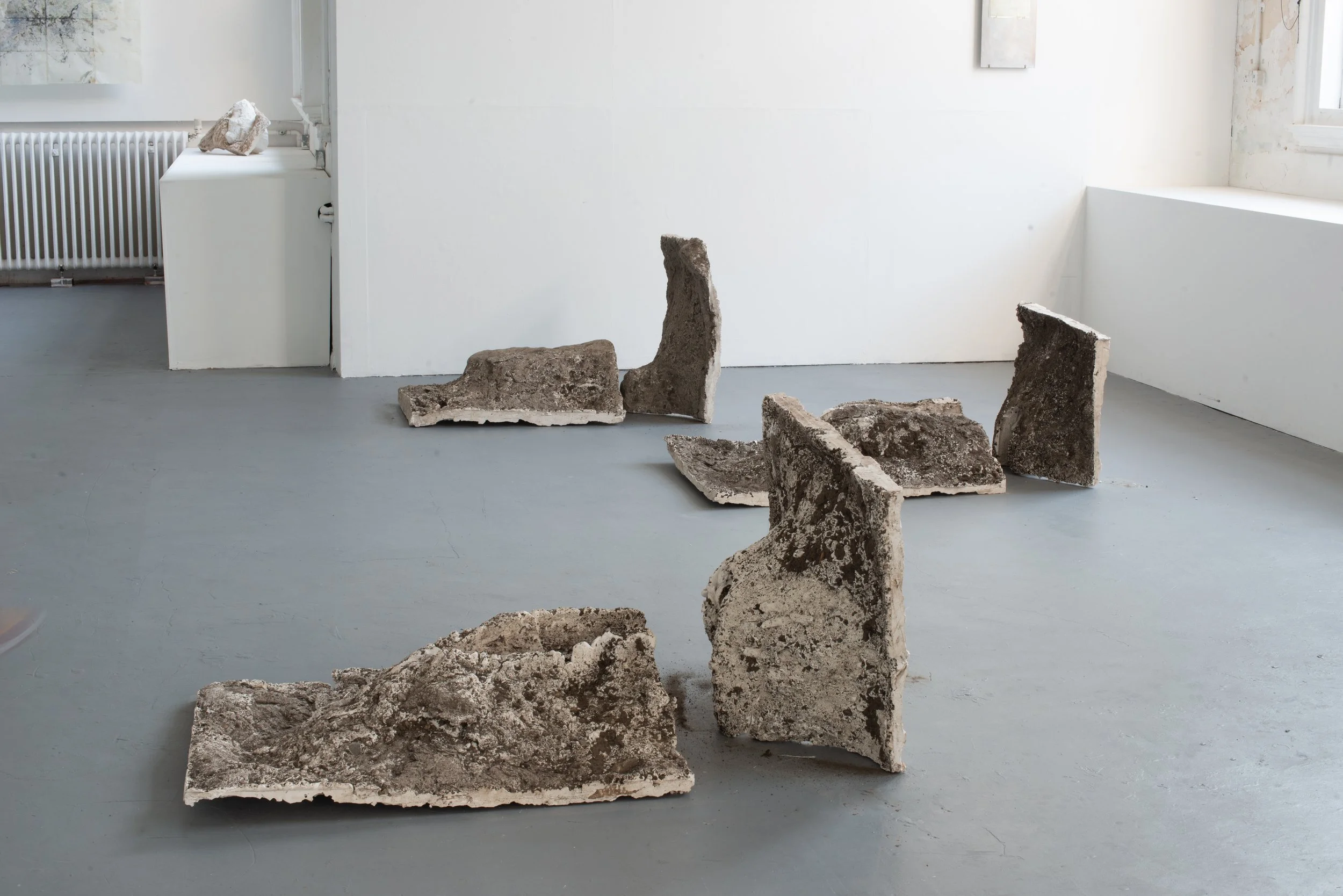
Te Palandjian, Garden Craters (2023).
To provide context on my indoor work since becoming a land-researching sculptor: I completed my first indoor land work, GARDEN CRATERS (UK, Spring 2023), a series of negatives taken from holes hand-dug and refilled three times in my back garden in Brockley, UK. Later, I collected 800 lbs. of British clay deposits, constructed pits for the clay in my studio, and conducted a series of movement-based performances in those pits before casting negatives I called “inscapes” (UK, Winter 2024). In collaboration with Nele Bergmans of Critical Edge Collective, I produced a call-and-response indoor installation titled Slowly, Extinction (UK, Summer 2024). Nele fabricated a spatial delineation; I responded. Our dialogue culminated in her acquisition of a weathered greenhouse, deconstructed into a single pane of glass. The breezeblocks that had framed the original structure were relocated to my back garden. Using these as spatial markers, I responded by reconstructing a local tree—charred Platanus cuttings—into a single composed form, referencing a Utah research trip where the trees were alive yet completely blackened by slow-burning heat.
Most recently, in TEST/SITE (UK, Winter 2025), we invited the public to observe us stacking synthetic strips—treated with grainy materials from Utah, the Jordanian desert, British chalk cliffs, or synthetic pigments—into configurations between breezeblocks. Meanwhile, in my solo practice, I spent the end of 2024 working with 144 gallons of dirt dug from my home in Boston, transported to Chicago to be cast and used as negative material markers of bodily movement in constructed studio pits.
The signifiers of the body are readily apparent, even in artworks that do not directly depict my appendages. My works, particularly those employing denser materials, tend to hover between four and five feet in height. Within the gallery context, I believe that bodily scale functions not as an immersive experience, but rather as a touchstone for accessing the psyche. In collaborative works with Nele, scale shifts, reaching 10 to 15 feet on a single side, reflecting the expanded capability of two laborers. These parameters emerge from my process: for the inscapes, the pits were four feet by four feet, allowing simultaneous hand and foot contact with the clay’s edges. In less dense materials, scale expands organically, as in Ocean Crater (2023), where I used taut-line hitches to hoist a 45 × 70 foot rope net over a harborside field in Deer Isle, Maine.
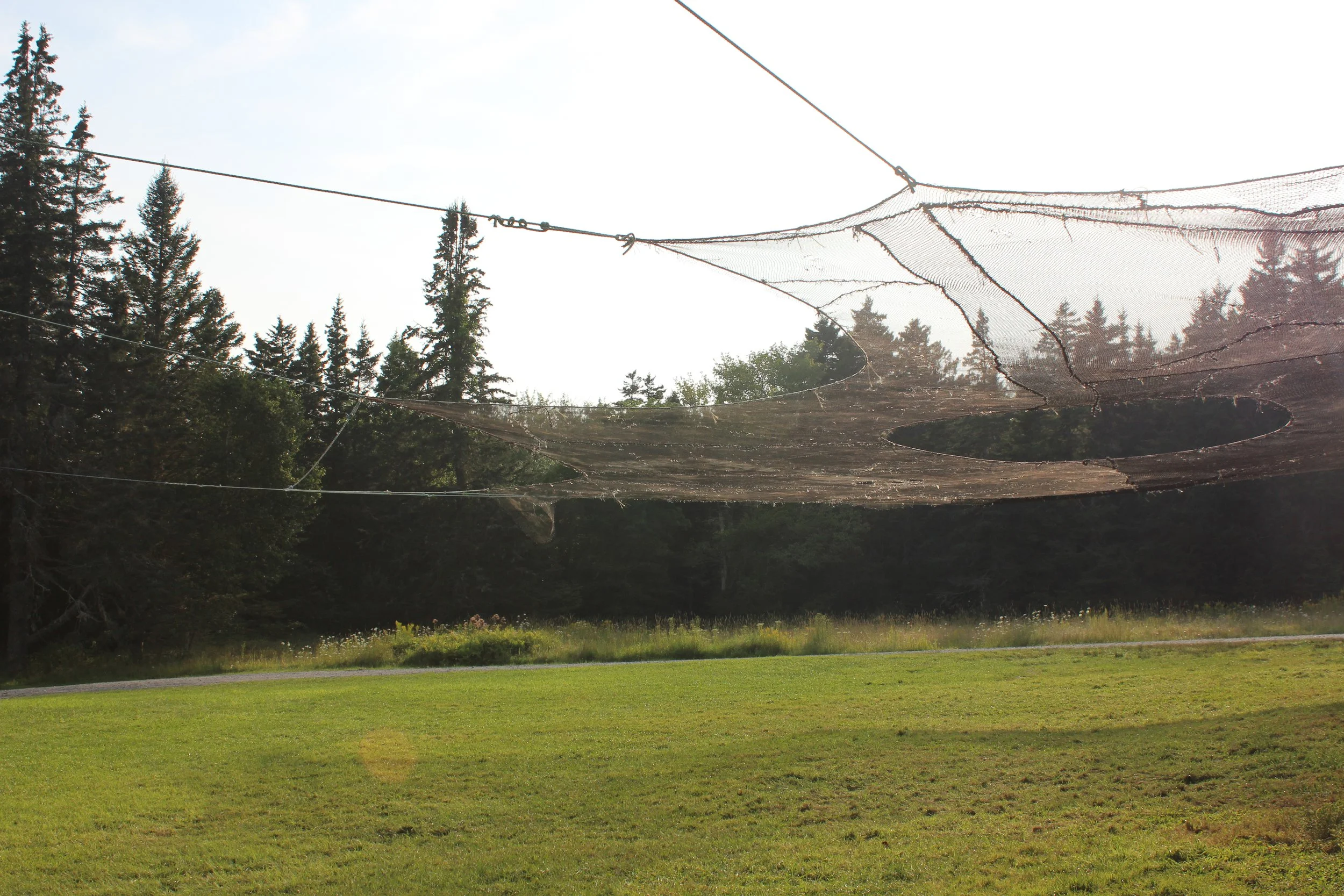
Te Palandjian, Ocean Crater (2023).
The critical turn for me lies in bringing the site indoors. While my outdoor works communicate directly with their surrounding landscape, indoor work positions me as the arbiter, with the sculpture serving as a new totem that stacks landscape with an accompanying psychological map. I am reminded of this when I wear my jeans in the city shortly after coming back from a site-trip. I reach into my pocket and find a little sand: a bit of land journeyed and resituated, specific to my memories, broad in its conceivable origin in a multiplicity of landscapes.
“The signifiers of the body are readily apparent, even in artworks that do not directly depict my appendages.”
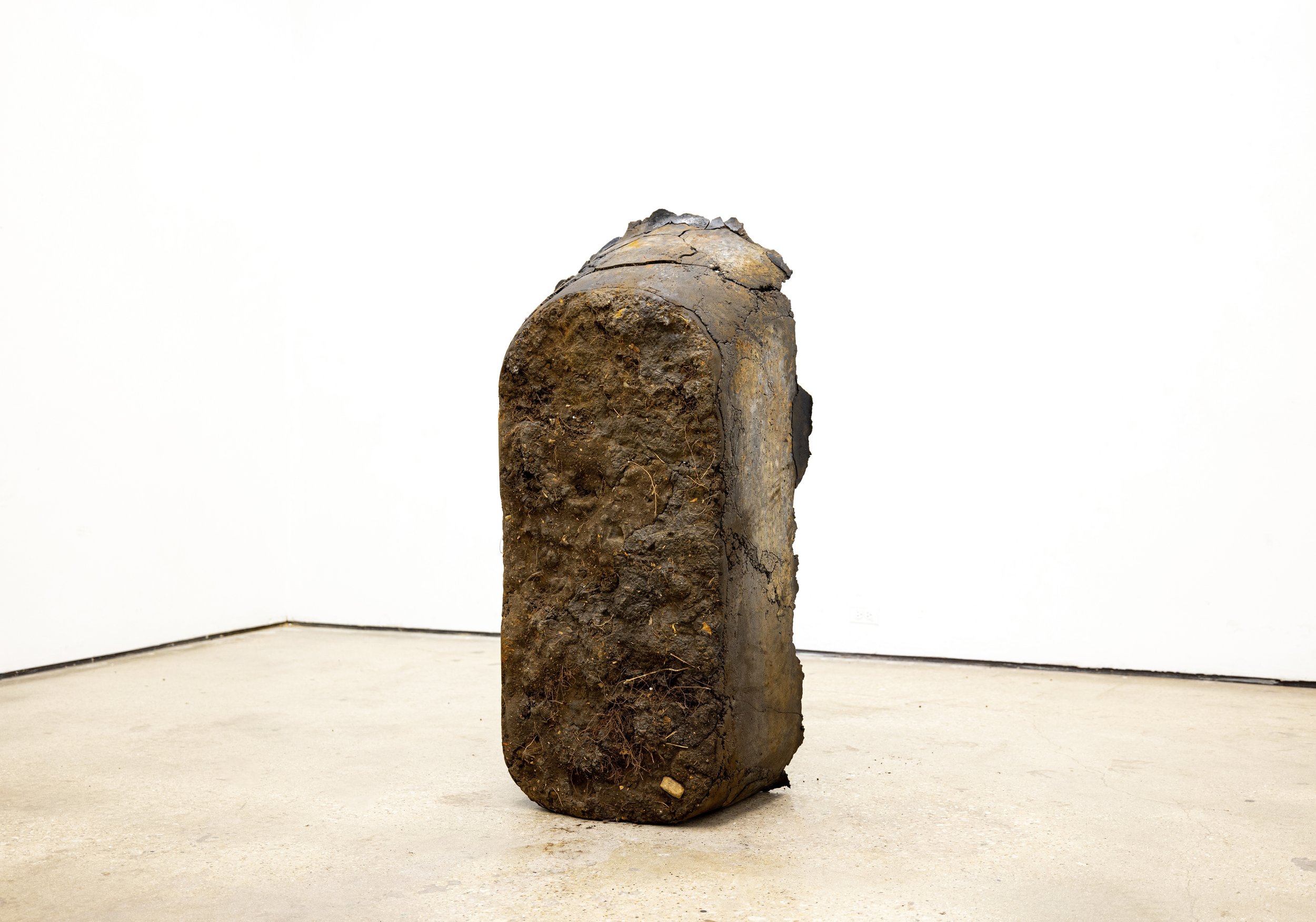
Te Palandjian, Designed for Contact (2024).
Footnotes
01. Ruth Schuster, “Archaeologists Solve Century-Old Mystery of Prehistoric ‘Desert Kites,’” Haaretz, Accessed December 4, 2022.
02. I should note that there seemed to be concurrent rumblings in Japan. Kazuo Shigara made Doro ni idomu or Mud Challenge in 1955, where he rejected conventional painting practices in favor of a psychic, bodily act. The work did not itself focus on a specific landscape, but the Gutai Group, for which he was a part of, and many other Japanese artists would go on to produce earthworks starting in the 60s. In the 1990s, Naoshima, Japan and nearby islands became a radical home of Japanese and American land art installations. I am interested in further developing an understanding about the connection between America and Japan land art that started during the post-WWII period, but for the sake of this journal, I will keep my focus narrowed to the American trajectory.
03. Brian Wallis and Jeffrey Kastner, Land and Environmental Art (London: Phaidon Press, 2006). Pg 12.
04. Rachel Carson published Silent Spring, a critique of chemical industry practices and the harmful effect on the environment in 1962. The Environmental Defense Fund (EDF) was founded in 1967, and the Sierra Club Legal Defense Fund (now known as Earthjustice) launched its first court case to protect Mineral King from ski resort development in 1965.
05. Rachel Carson, Silent Spring (Boston: Houghton Mifflin, 1962).
06. “Environmental Defense Fund Archive,” Stony Brook University Libraries.
07. “How The Earth Got A Lawyer,” Earthjustice.
08. In a 1970 New York Times Article, “It’s Called Earth Art-And Boulderdash: Earth Art—or boulderdash?,” Roy Bongartz describes the outrage that land art was generating for the New York art scene, and the boldness of making work that not only could not sell in the gallery, but often required vast funds to fabricate and denied audiences viewership.
09. In an interview with John Gruen in 1977, Michael Heizer was highly critical of curators, stating, “frankly, I’m tired of having my scene slowed down by people who don’t get what I’m doing. I’m working, but they’re not working. That’s very upsetting. Look, I don’t think of myself as an artist who’s running around expressing himself. I feel I’m performing a function for society. I think my work is important. Curators of museums are negligent. There are exceptions, of course, but most of them aren’t really doing anything. . . anything that’s important.”
10. John Gruen, “Michael Heizer: ‘You Might Say I’m in the Construction Business,’”ARTnews76, no. 10 (December 1977): 97–99.
11. “Land Art,” Tate. This definition refers to the land art genre generally, not just the one that emerged in the 1960s.
12. Sigrid Holmwood, “Cannibal and Witch Eat the Rich,” sigridholmwood.co.uk.
13. I define “indexical” as something that directly points toward or is physically connected to something real, concrete, or physical in the world. For instance, marks, traces, or imprints left on a medium may serve as evidence of a real-world event or presence.
14. Brian Wallis and Jeffrey Kastner, Land and Environmental Art (London: Phaidon Press, 2006). Pg 12.
15. The roadtrippers stand as the pioneers of land art, among the most significant in the field, but it should be noted that Heizer largely rejects his alignment with other land artists of the time. In the same 1977 interview with John Gruen, he argued, “my work is fully independent of anybody else’s, and comes directly out of myself.”
16. “Biography of Robert Smithson,” Holt/Smithson Foundation.
17. Robert Smithson, A Provisional Theory of Nonsites, 1968, in Robert Smithson: The Collected Writings, ed. Jack Flam (Berkeley: University of California Press, 1996), 364–367.
18. Ibid.
19. Kirsten Swenson, “’The Last Nonsite’: Nonsite, Site Uncertain, Politics, and Prehistory,” Holt/Smithson Foundation, October 2023.
20. Ibid.
21. “Teresita Fernández / Robert Smithson,” SITE Santa Fe.
22. Teresita Fernández and Carla Acevedo-Yates, “Teresita Fernández / Robert Smithson,” YouTube, 1:28:55, posted August 22, 2024.
23. Teresita Fernández, “Teresita Fernández: Paradise Parados,” YouTube video, 19:19, posted by National Gallery of Art, April 21, 2023.
24. At a bare minimum, I contend, and believe Smithson himself would contend, that his theory of nonsites works in “polarities.”
25. Jane Blocker, Where Is Ana Mendieta?: Identity, Performativity, and Exile (Durham: Duke University Press, 1999).