Florian Idenburg
On Body and Performance
Architect, educator, and author Florian Idenburg and his partner Jing Liu founded the firm SO – IL in Brooklyn, NY. Since their beginnings in 2008, their practice has gained significant recognition, recently being awarded a United States Artists Fellowship, which celebrates artists who have contributed to the creative landscape of the country. SO – IL explores the conceptual theme of an urban gradient where space is considered a porous field and the delineation of architecture within it is blurred. SO – IL has created small and large spatial events that experiment with this idea, having translated their ideas and designs around the globe, and across living, work, civic, and institutional spaces.
The intricacies of each project – the soft nuances, subtle layers, details in materi ality – surmount to a cohesive and fresh awareness of architecture. It’s an archi tecture that imagines new ways of living in a complex, interconnected world and encourages open interpretation. Idenburg currently teaches at Cornell and is devel oping a forthcoming publication on the future of the workspace, titled Human(s) Work. Idenburg is a highly energetic, enthusiastic, and engaging conversation alist, whose dynamism traversed from his digital screen to mine (the interview was conducted remotely due to COVID-19).
This interview has been edited for brevity.
RM1000: I’d like to start our conversation by asking how you define “performance” in the context of architecture.
FI: When you say ‘body and performance’ the initial thing I’m drawn to is how architec ture makes the body behave in space and allows the body to perform. The perfor mance of a building in a more technical manner is something we are obliged to think about as architects. But we are more interested in the way architecture can have an impact on our senses and stimulate or trigger a body to behave in a certain way. It’s one of our main motivations and something we consider quite a bit.
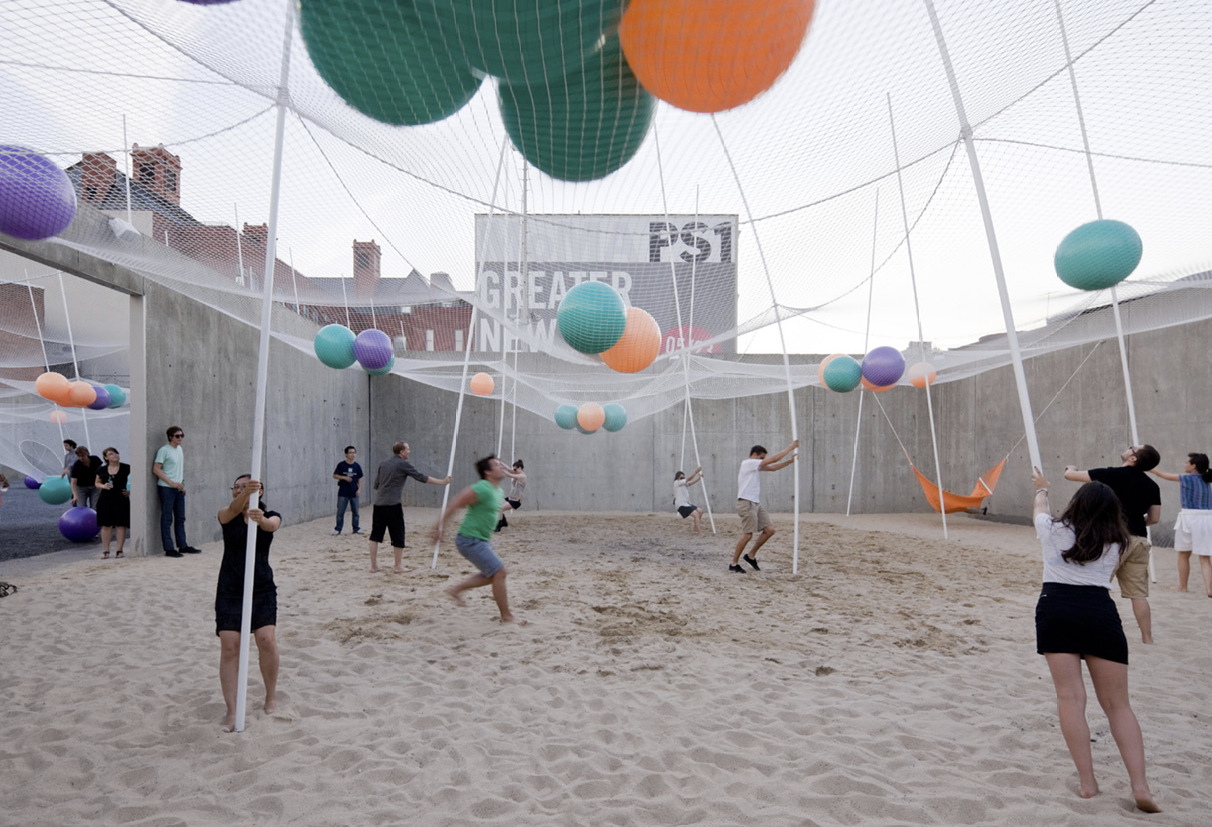
One of our first projects, Pole Dance, reacted to the idea of modernity and the way we use systems and structures to organize our life. Systems are not neces sarily rigid but are pliable. We, as beings and bodies, can actually affect their structure. In Pole Dance, we were trying to motivate people to engage with a wide grid, which was a metaphor for that Modernist cartesian envelope. It was also a response to the fact that we’re spending a lot of time in the digital realm – how do we agitate bodies to get physical? We wanted the architecture to push back, be responsive but also volatile, so it could slap you in the face like, “HEY, wake up!”
You can think of an architecture that stimulates the senses through tactility, through materials, the way you touch a wall or door handle. But we also think about larger, complex systems and their effects on our bodily experience. Not just the brick wall but modernity or climate change, for instance. Architecture needs to do a lot of things, but it also needs to have an idea. A building is a building and architecture is a building with an idea.
RM1000: Your article Cocooning looks at using interior architecture to ease the boundary between public and private spheres. Why is it important to make that boundary more porous?
FL: The boundary is actually very porous. The idea that there is a line where one side is public, and one side is private doesn’t exist. And the idea that ‘the public’ is an endlessly connected open space in which everyone is equally, publicly, universally together is also not true. Boundaries and edges are very precise, very subtle, and very fluid. Even now as we think about Coronavirus, the borders of countries are different every day, and different for different people. There is no line, there’s only a mesh. An endless in-be tween zone. We’re only calibrating very precise definitions of these borders. That understanding of architecture, which is thinking through very subtle layers, filters, and fabrics, is a more deep and conscious thinking of public and private.
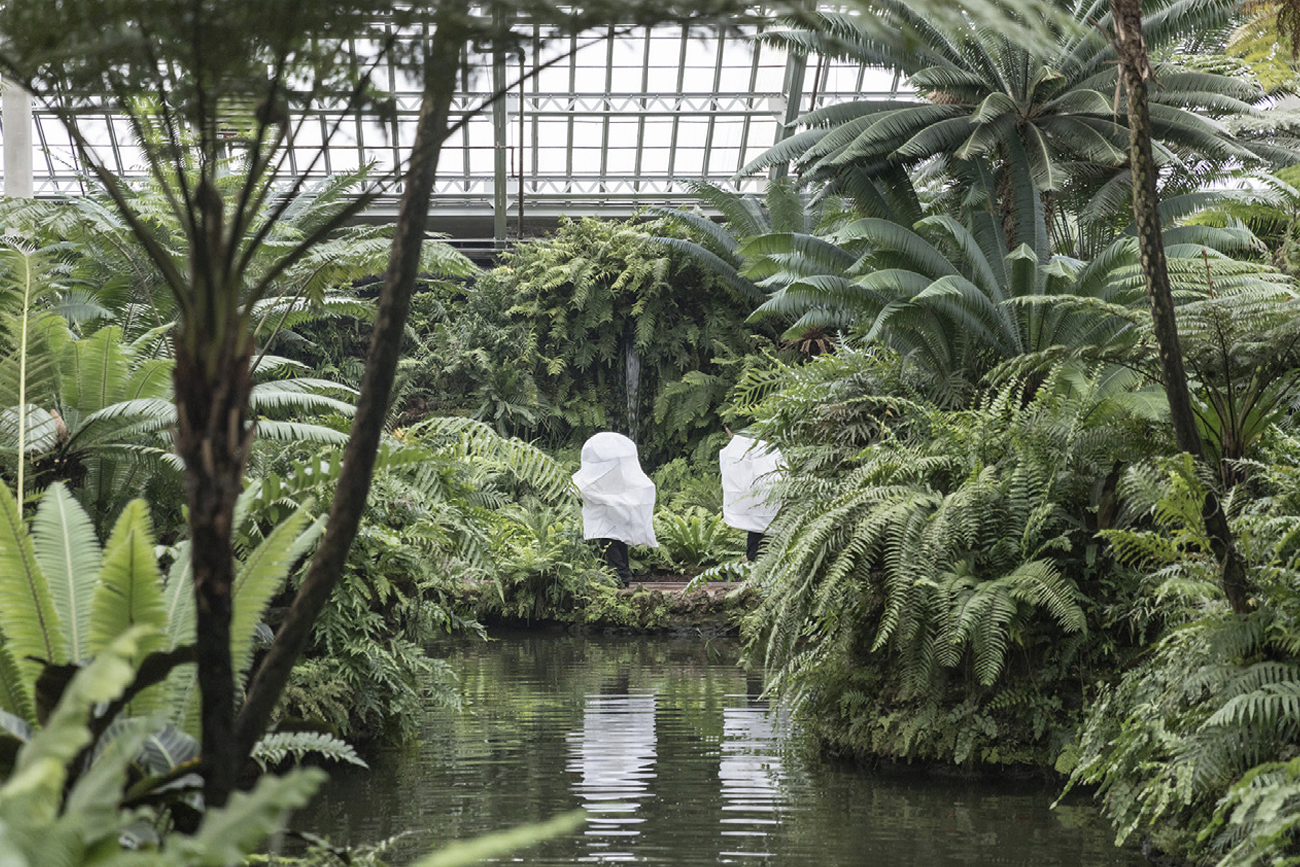
We are always somewhere in between the public and the private, maybe a little bit more on one side or the other, as is the person next to you. We’re interested in creating spaces and zones that are not one or the other, but in which you could think, “Hey, where am I right here?” We want to question preconceived notions of how certain things are, hone in on them, and see if it’s true. As we zoom in, things are more complex, more subtle, more intricate. We are attempting an architecture that makes people a little bit more aware of who they are, where they are, what their position is, and how they relate to all the things around them.
“What we try to do in the process of designing is produce an environment that might heighten the awareness amongst some of us.”
RM1000: How do you anticipate and respond to the reality that there are infinite potential performances even in a single person’s daily life? Are there intrinsically human values that you can distill?
FL: Everybody responds in different ways to different inputs and senses. You need to be elastic. The Corbusian figure is not what we should be using as the base for all our design. It’s always the question of “who” feels. Everybody’s feelings are different, and we live in an age where individual feelings are extremely at the forefront of how we think. If architecture needs to be a machine that solves all these feelings for everybody, that’s a total impossibility. We are more interested in the subjective interpretation of things.
There is not a “correct” way to experience something. There are things that stimulate the senses, with light, touch, sound, but it’s not “you shall understand it this way.” If we both touch something cold, we might have different reactions but it’s still cold. What we try to do in the process of designing is produce an environ ment that might heighten the awareness amongst some of us. Some people are more numb or less interested, and there are also highly sensitive people who are extremely aware of their environment.
RM1000: In the Las Americas project in Leon, Mexico, you directly engaged residents through workshops before introducing a new vertical social housing typology to the area. What is the role of the architect in nudging behavior or changing preconceptions?
FL: Leon is a very good example. You sometimes have to nudge the individual into something that is better collectively and make that an attractive thing. As architects our job is to imagine other ways of living, maybe things that not everyone can imagine themselves. We can’t make decisions for others because everyone has their own lived experience, but at the same time, it’s the architect’s responsibility to imagine things at a larger scale that might be good for our collective human body, not a translation of everyone’s individual desires.
RM1000: In that project, you expected the owners to take authorship of their own residences, painting, building onto it, transforming it in some way.
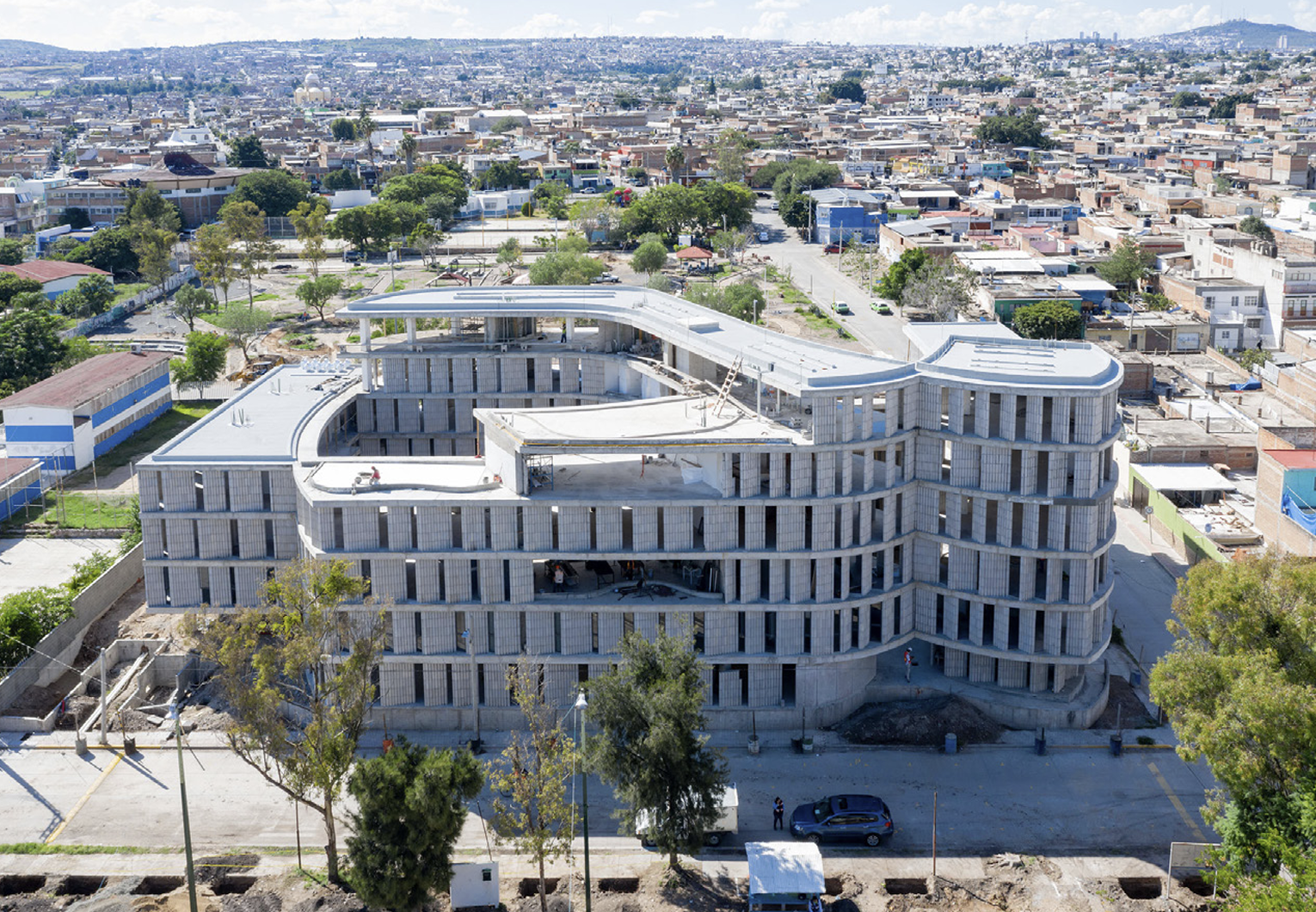
FL: It’s nicer because it’s like jamming in a way. You see how somebody responds. Umberto Eco’s The Open Work argues that every piece of artistic creation relies on the user to complete it. The work is only complete at the moment it is interpreted, understood, and consumed by an audience. In this idea of openness, of making a structure that is not fixed or singular but with a user who can have an interpretation and understanding, there’s a kind of looseness. That’s why we totally don’t believe in function as a driver because nobody behaves in an exact way. You can do whatever you want in a space. Architects need to organize a building so that it allows certain things and maybe doesn’t allow other things.
FL: Another example is the Kukje gallery in Korea. The gallery’s form, which is quite unique and specific, is just the result of the way something falls. That fabric has a certain material behavior, and you can drape it again and it falls differently. We were not interested in the exact form it would make; we were inter ested in the process of this material.
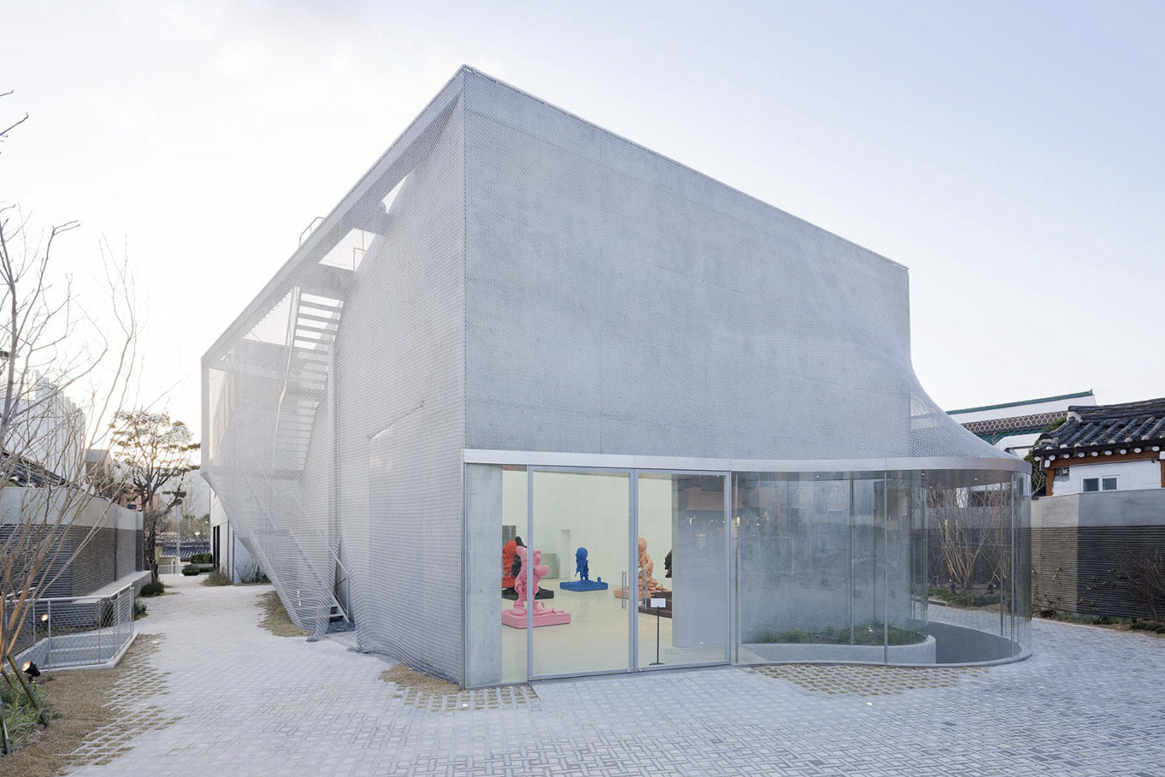
The nuance is in which things you define, and which things do you leave open for interpretation. Architecture is much more about improvisation and figuring it out as you go, than about nervously holding on to things that you came up with.
“How do you create a space for bodies to come together, and how do they become aware of one another in space?”
RM1000: Your work explores new ways of living and the interplay between physical and digital environments. Could you elaborate on your idea of the digital being an organizing factor to the physical?
FL: The digital liberated architecture. This may be an all-encompassing statement but it’s a good one to provoke thinking. If you think of the city grid, you can count avenues and streets and you know where to go. It is a very useful way of under standing how to navigate. At this moment, the digital is what organizes our day, our rhythms, even space. We just look at our phone and follow wherever the phone tells us to go. So suddenly, architecture doesn’t have to do that anymore. It doesn’t have to be such a rigid, organizational structure anymore, it can be liberated. You can make the most chaotic, labyrinthian organization and you could still figure out where to go.
FL: Space is liberated from having it be that organizing structure, and even function. If you think about function, like the Modernist mantra that form needs to follow function, everything now happens online. Every single function - shopping, or whatever you do - happens online. So, space doesn’t have to be a specific function anymore either. It can suddenly be all these things that it previously couldn’t.
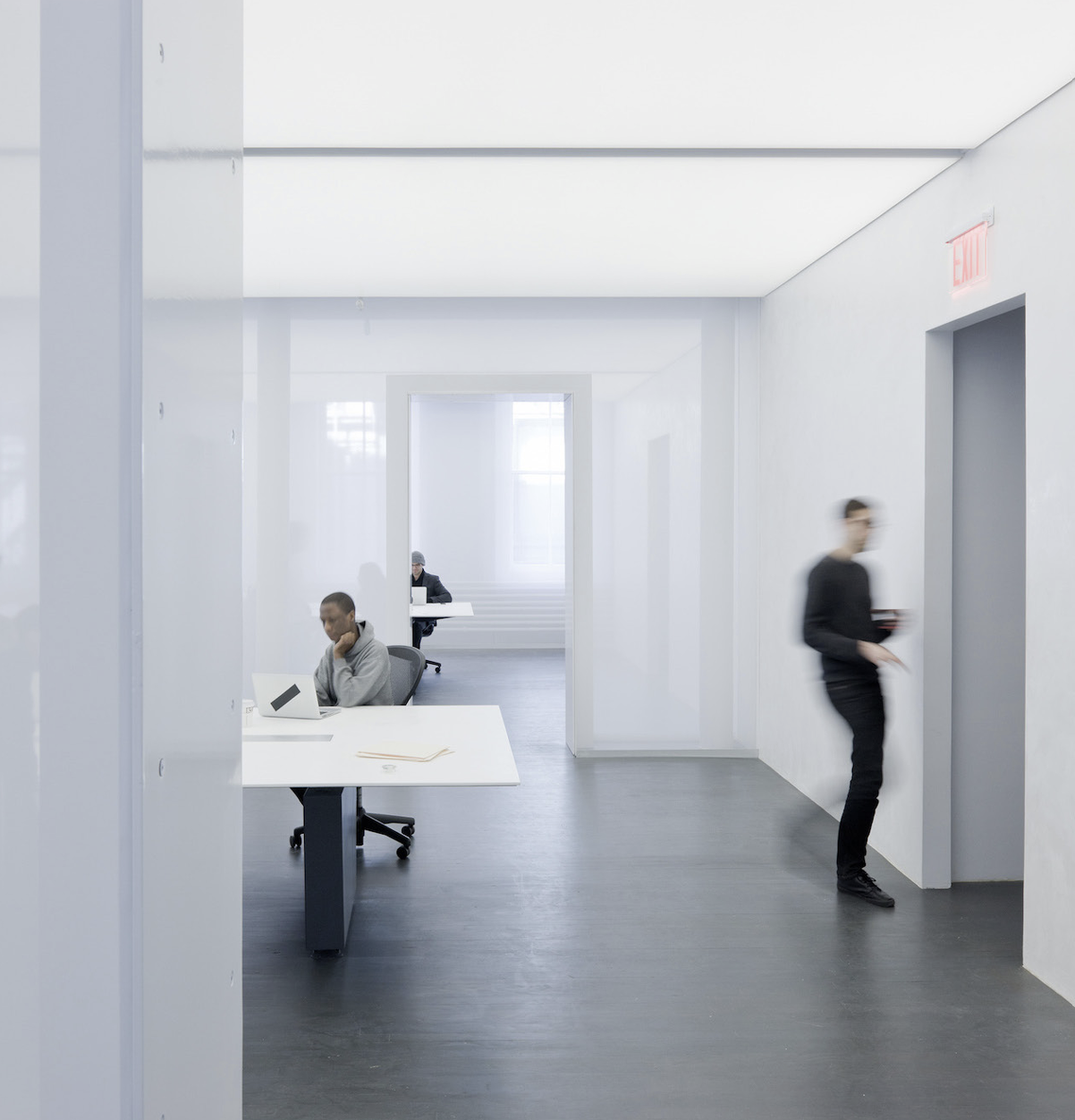
Our project for Logan was to design an office for a fully digital company. They wanted a New York outpost primarily for hosting people and having in-person meetings. How do you create a space for bodies to come together, and how do they become aware of one another in space? How do you organize a space for a company that works fully digital and only has freelancers that come in for a project and then disappear again? These are very sensorial things, much less to do with order, organization, and function. It is a much more fluid body of people that come together and disappear.
RM1000: In your article Abstainability from 2011, you discussed the use of neuroscience to measure sensorial performance of architecture. How does data inform or relate to the work that you do today?
FL: Our spaces are so complex, and every body behaves in unique ways. Within architecture, we are certainly not yet at a place where we can make any useful predictions. I was recently listening to a podcast about self-driving cars and how the neural networks in these cars respond. Products always go faster than spaces because architecture is so hard to repro duce; every location, site, part of the plan, and solar orientation is unique. But that knowledge exists. You see it more in self-driving cars than in architecture, maybe you can see it more in the metaverse.
Our life is already very much lived through predictions about the way we would behave, but humanity is much more complex and there are unknown unknowns that have effects. Predictions are based on past information, which means they foreclose the unknowns. We’re inter ested in the irrational, the unexpected, or misinterpretations. In those things – the glitches and mistakes in the model – you f ind things that you otherwise wouldn’t have been able to find. No matter how much information you have, there’s always some sort of unknown. And that unknown is more interesting to us.
RM1000: It seems like you have a kind of architectural humility, where architecture comes second to natural forces and systems. How does this influence your designs?
FL: This is something Jing and I talk about a lot. I don’t think it’s humility, it’s more of a general, larger perspective of how small one single human life is in the entire history of humanity and of the planet. We’re unlearning some of the modernist heroics of the empty slate and the idea of a tabula rasa. As architects, we were taught that you have empty slates of land in which you are going to set your vision, and it would be that way for eternity. It is truly not the awareness that we have now in our world. We’re doing some work in the Netherlands where authorship is extremely protected. Once you build something, you are the only person that can change it. I think that’s ridiculous. You shouldn’t remain the intellectual owner of that space. People should do with it whatever is right at that moment.